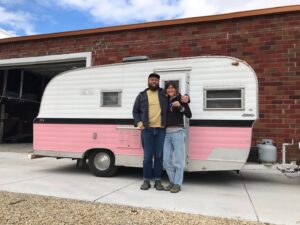
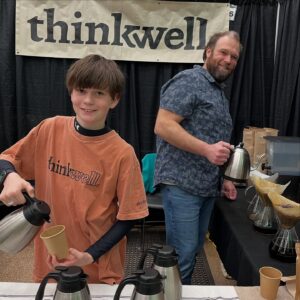
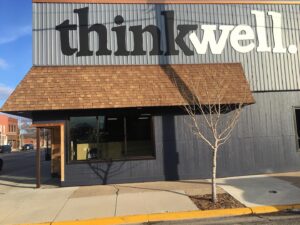
The Co-op recently welcomed thinkwell.coffee of nearby Waverly to the store. This local roasterie is the creation of Erik and Rebecca Ruth Johnson of Waverly.
We reached out to Becky and Erik with questions – lots of questions. We asked about sourcing, about coffee specifics, about business practices, about production, and about how they dream to serve their local and global economies.
The result? This duo thinks well. Their website’s a rich, flavorful drink of raison d’etre – displayed in words and in video. We suggest checking out Becky and Erik in conversation here: https://www.thinkwell.coffee/about/. Learn more in our Co-op Q&A below:
OCC: What would you like to tell Co-op shoppers about your roasting process?
thinkwell.coffee: We approach roasting like skilled art – like a sculptor to stone, or a potter to clay. The industry we’re in often treats coffee like a commodity; the goal is to crank out batch after batch trying to make things automated, and identical. That’s not us. We roast by paying attention to each batch and its details, allowing us to make every batch as good as we can possibly make it. We allow roasting coffee to be what it is – a “kaleidyscope” of flavors and expressions. It’s like music you can drink.
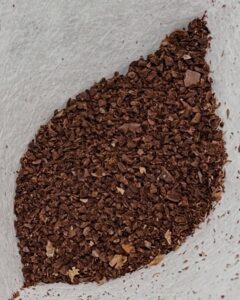 OCC: You’ve mentioned that “coffee has infinite expressions.” What does roasting temperature have to do with this? How does it define the finished product that winds up in our cup?
thinkwell.coffee: Finish roast temps in coffee are communicating “light, medium, or dark roast” in a clearer, more objective way. The lower the temp, the lighter the roast. The higher the temp, the darker the roast.
We chose to use finish roast temp because the roasting process is the definitive point of creation for coffee. We want people to have information about the coffee they are drinking, and to have that information be accurate and helpful – connecting the taste in the cup to the process.
Relevant information about the roast tells a person so much about the flavor they’re experiencing. For instance, “light roast” can be anything from 385F to 412F. They all fit under one category, but the taste in cup can be incredibly different – and consumers don’t have the relevant information to understand why they like some and not others.
OCC: We love to hear about product sourcing; could you provide info on your farmers, and their beans?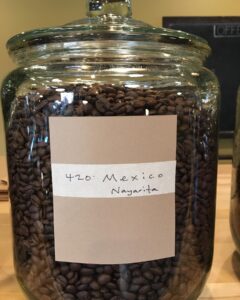
thinkwell.coffee: We’ve worked directly with farmers and millers. We founded our own coffee program at point of origin. We collaborate on growing, milling, harvesting, and export. We seek to find farmers and farm cooperatives who care about lifting up their families and communities
and who want to do the very best in caring for the land through growing coffee. We’ve been working with some communities for over 10 years, and for some, it’s our first season.
OCC: Sustainable business practices are a cooperative value. How do you contribute to a sustainable future?
thinkwell.coffee: Our values are consistent, and our product has integrity. When a person purchases our coffee, they should know their money is going to support a community of people – some here in Iowa, some in distant lands – all working in harmony with each other and the earth.
 OCC: Let’s hear about YOU! What’s your “why?” Who are you – as people, entrepreneurs, and members of local, regional and global communities?
thinkwell.coffee: We’re business owners, but running a business was never “the plan.” The first and primary thing we were chasing after was the answer to these questions:
Is it possible for people to take care of each other and the earth, to exist harmoniously as a whole?
Can we provide meaningful/purposeful work, provide security, and improve the communities in which we live through our daily work?
It’s our seeking the answers to these questions, coupled with experiences in the coffee industry, that’s led us to where we are today. This journey has brought us to the current form of our business – sourcing incredible coffees from communities who share our values from around the world, and roasting for households in our region. Our little communities here in NEIA are helping support the lives of people from 22 different communities around the world, in 14 different countries.
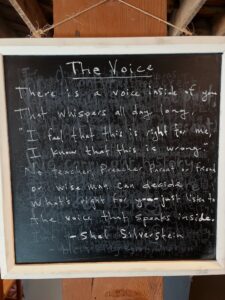
We are wilderness people. Ruth and I grew up (mainly) in Minnesota. We met guiding canoe trips in northern Minnesota. We lived (in a VW camper van) and worked for years in British Columbia, Washington state, Arizona, and Utah. We’ve enjoyed exploring the Driftless – camping, canoeing, and fishing with our four kids. We love playing music and reading poetry. You might even catch a music or poetry event at our shop in Waverly.
 OCC: Lessons learned? Steps forward?
thinkwell.coffee: We’re still progressing, still learning. We’ve had many challenges and setbacks, but we decided to just keep going. We’ve acknowledged pitfalls and limits, and retain a hope-filled vision of what’s possible. And now here we are! Over five years of running thinkwell.
The fact that we continue to operate and accomplish our mission goes to show you: You Can Do It! We can live voluntarily in harmony with each other. We can provide good things for people, while taking care of each other and the earth.
We view our role as the people who will hold on to this dream, protect this space for all who want to participate, and continue participating in community by creating beautiful coffees for people to drink.